
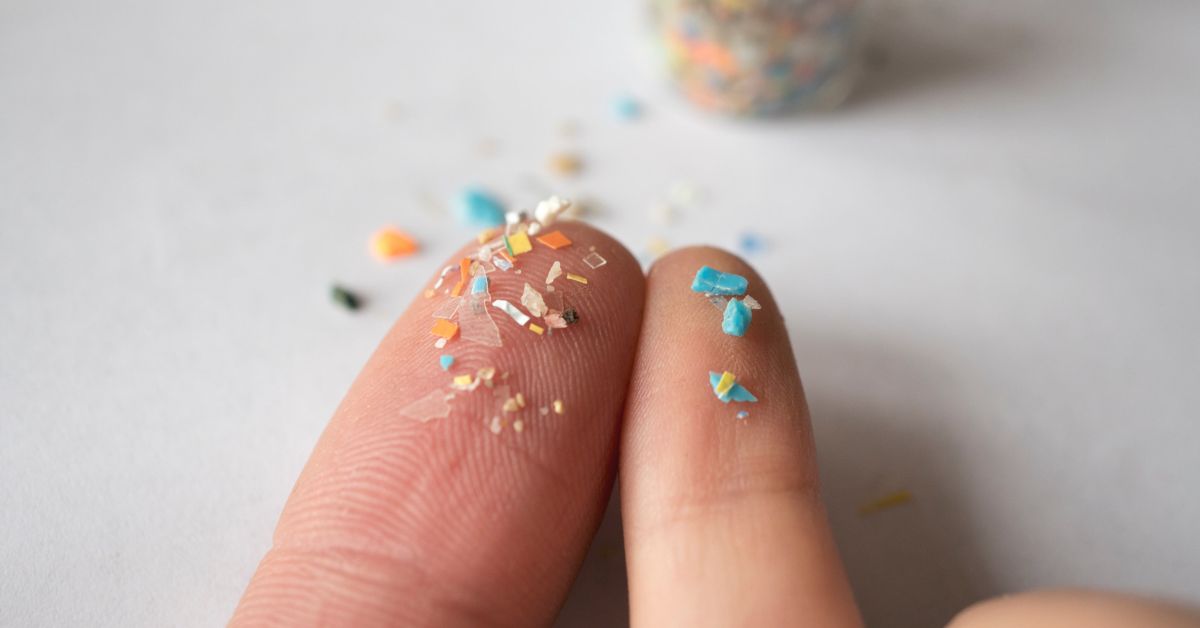
If you’ve followed health news over the past few years, you’ve watched microplastics go from an ocean problem to a people problem. These tiny plastic fragments have now been found in human blood, lungs, heart tissue, the liver, the placenta and even the brain.
For most of that time, the honest answer to “So what can I do about it?” has been: reduce your exposure and hope for the best. That’s still good advice. But new human research on Therapeutic Plasma Exchange (TPE) gives us something we haven’t had before: a clinical intervention that measurably lowered circulating microplastics in the blood, with before-and-after testing to show it.
Here’s what the research found, what it doesn’t tell us yet, and how we’re using it at Tringali Vibrant Health in Palm Beach, Florida.
Where do microplastics in the body come from?
Microplastics are plastic particles smaller than 5 millimeters; nanoplastics are smaller still, often invisible even under a standard microscope. They come from the breakdown of everyday plastics (packaging, synthetic fabrics, tires, cookware, water bottles) and reach us through the air we breathe, the water we drink and the food we eat.
The concern isn’t only that we’re exposed. It’s that some of these particles don’t simply pass through. They can accumulate in tissues over time.
Are microplastics harmful? What the research shows
Two studies in particular have changed the conversation:
- The heart. In a 2024 study published in the New England Journal of Medicine, researchers examined plaque removed from the carotid (neck) arteries of 257 patients. Those whose plaque contained micro- and nanoplastics had roughly 4.5 times the risk of heart attack, stroke or death from any cause over about three years, compared with those whose plaque showed none.
- The brain. A 2025 study in Nature Medicine found micro- and nanoplastic concentrations in human brain tissue 7 to 30 times higher than in liver or kidney samples, with higher levels in brain samples from 2024 than from 2016.
An important caveat, and one we’ll always be upfront about: these are observational studies. They show strong associations, not proof that microplastics cause heart disease or cognitive decline. But in functional and longevity medicine, we don’t wait for every question to be settled before paying attention to a modifiable risk.
Can you remove microplastics from your body?
Filtering your water, choosing glass over plastic, not microwaving food in plastic containers, and cutting back on ultra-processed food all reduce how much new plastic you take in. We recommend all of it.
What avoidance can’t do is address what’s already circulating. Until recently, there was no clinically studied way to actively lower that burden.
New study: plasma exchange lowers microplastics in the blood
Circulate Health researchers studied whether Therapeutic Plasma Exchange could reduce microplastics in human blood. They tested patients before and after TPE using a validated blood assay (Plastictox), analyzing 174 TPE procedures across 114 people, the largest human dataset on this question to date.
The results depended heavily on how much microplastic a person started with:
Microplastics in the blood before and after one TPE session
Average particles per 100 µL, grouped by each patient's starting level
Source: Circulate Health clinical study summary, 2026 (174 TPE procedures, 114 patients; pending publication in ASFA proceedings). At low starting levels, particles shed by apheresis tubing and blood-warming equipment offset the removal effect.
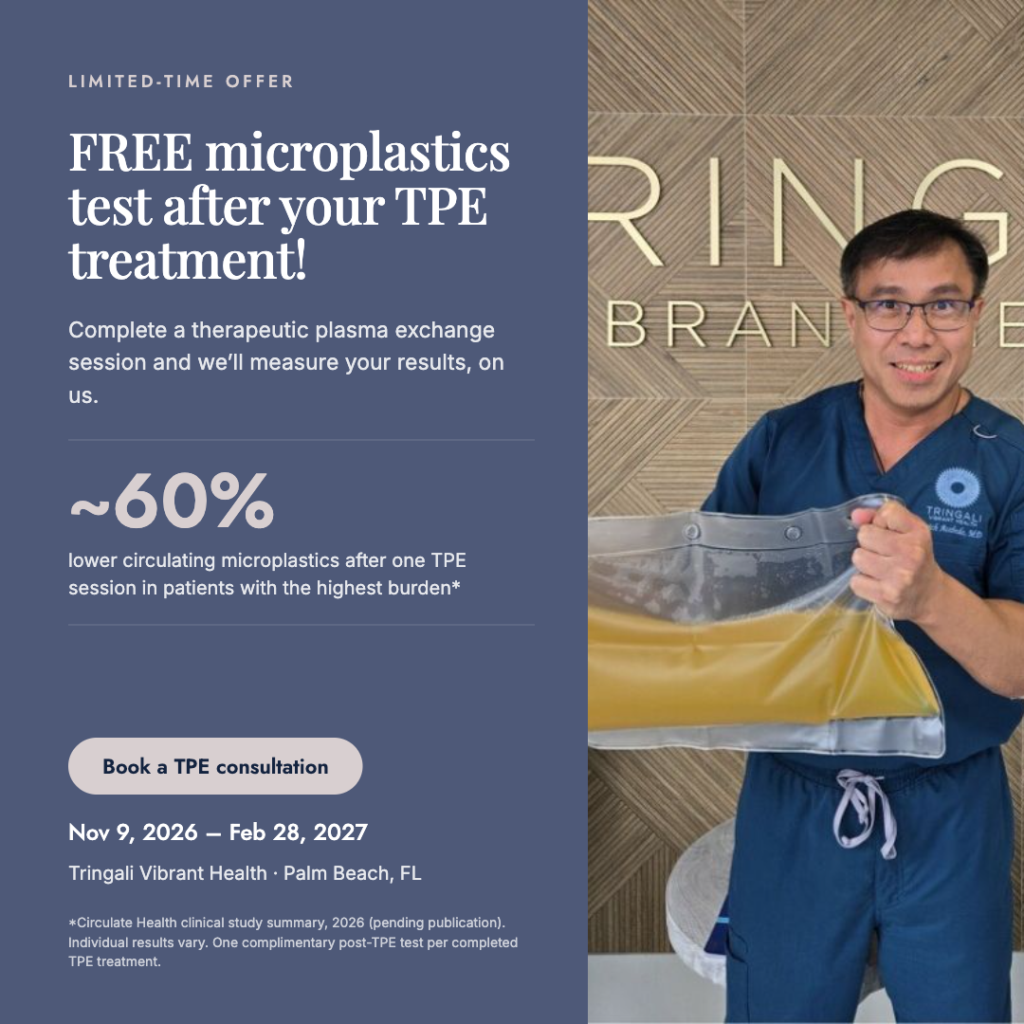
The headline: in people with the highest microplastic burden, a single TPE session lowered circulating micro- and nanoplastics by nearly 60%. All procedures in the study were well tolerated, with no adverse effects reported.
Why a microplastics blood test matters before TPE
Notice the bottom row. In people who started with low levels, microplastic counts actually went up after TPE. The researchers traced this to the equipment itself: the plastic tubing and blood-warming components used during apheresis can shed small amounts of plastic. In people with a high burden, the removal effect far outweighs this. In people with a low burden, it doesn’t.
We think this is one of the most useful things the study tells us, and it’s exactly why we test rather than guess. TPE isn’t a one-size-fits-all “detox.” Knowing your number helps you and your provider decide whether it makes sense for you at all.
What is therapeutic plasma exchange (TPE)?
TPE is a well-established procedure that hospitals have used for decades to treat certain immune and blood disorders. During a session, blood is drawn and passed through a machine that separates out the plasma, the liquid portion of your blood that carries proteins, waste products and circulating particles. That plasma is removed and replaced with a fresh solution, typically albumin, and your blood cells are returned to you.
In longevity medicine, TPE is being explored as a way to clear unwanted material from circulation. This new study adds microplastics to that list, with real before-and-after data.
Microplastics testing and TPE in Palm Beach, FL: our approach
At Tringali Vibrant Health, our philosophy is simple: if we’re going to recommend an intervention, we want to measure whether it worked. For microplastics, that looks like this:
- Establish your baseline with validated blood testing.
- Decide together whether TPE is appropriate, based on your levels, health history and goals.
- Complete TPE if it’s the right fit.
- Test Microplastics so you can see your results in black and white.
- Build a long-term plan that pairs any treatment with practical steps to reduce ongoing exposure.
Frequently asked questions
Is one TPE session enough?
The study measured the effect of a single session. How many sessions make sense for you, and how often, is a conversation to have with your provider based on your results.
Does lowering microplastics in my blood remove them from my organs?
We don’t know yet. This study measured microplastics circulating in the blood. Whether lowering blood levels over time affects what’s stored in tissues is an open research question.
Will lowering my microplastic levels improve my health?
The study suggests the biggest benefit is for people with higher starting levels, which is why we start with testing. Your provider will also review your overall health before recommending TPE.
Who is a good candidate?
That hasn’t been studied yet. What we know is that higher microplastic levels are associated with worse cardiovascular outcomes, and that TPE can measurably lower circulating levels in people with a high burden.
Is TPE safe?
TPE has a long track record in hospital medicine, and in this study all procedures were well tolerated with no adverse effects reported. Like any medical procedure, it has potential risks, which your provider will review with you.
Sulforaphane: helping your cells take out the trash

Some of the most exciting research in this space centers on sulforaphane, a compound your body makes from broccoli and especially broccoli sprouts. Scientists are exploring whether it could help with the other half of the microplastics problem: particles that have settled inside our cells.
How it works
Every cell has its own recycling center, called the lysosome, that breaks down waste. Plastic can’t be broken down, so particles can end up stuck there. Sulforaphane activates two of the body’s master cleanup switches:
- Nrf2 turns on your antioxidant and phase II detoxification enzymes. In a clinical trial led by Johns Hopkins researchers, a broccoli sprout beverage increased how much of two common air pollutants, benzene and acrolein, people excreted.
- TFEB tells cells to build more lysosomes and to push their contents outside the cell, a process called lysosomal exocytosis (lab research). Researchers are investigating whether this “take out the trash” signal could help cells release stored particles.
What researchers are watching
In a widely discussed 2025 self-experiment, a researcher measured a sharp rise in his blood microplastic levels after a high dose of sulforaphane, which he believes reflects particles moving out of tissues and into circulation. It’s an early, single-person observation, and formal studies are the next step, but it’s a fascinating signal and one we’re following closely.
Everyday support for your body’s natural detox
Our Vibrant CDG DIM+ pairs [sulforaphane form and amount per serving] with DIM to support phase II detoxification and healthy estrogen metabolism. It’s a simple daily addition to the exposure-reducing habits above. Ask your provider whether it belongs in your plan.
The bottom line
Microplastics are no longer a distant environmental issue; they’re a measurable part of human biology. Reducing exposure still matters. But for the first time, there’s human data showing that circulating microplastics can be meaningfully lowered, especially in people who carry the most. And there’s a way to know where you stand.
If you’re in Palm Beach County and you’ve been wondering what’s in your blood, now is a good time to find out.
This article is for educational purposes only and is not intended to diagnose, treat, cure or prevent any disease. Individual results vary. Talk with a qualified healthcare provider before starting any treatment. The Circulate Health study is pending publication in ASFA proceedings.
References
- Circulate Health. Plasma Exchange Reduces Microplastic Burden in Human Blood: Clinical Study Summary. 2026. Pending publication in ASFA proceedings. circulate.health
- Marfella R, et al. Microplastics and Nanoplastics in Atheromas and Cardiovascular Events. N Engl J Med. 2024;390(10):900–910.
- Nihart AJ, et al. Bioaccumulation of microplastics in decedent human brains. Nature Medicine. 2025;31(4):1114–1119.
- Egner PA, et al. Rapid and sustainable detoxication of airborne pollutants by broccoli sprout beverage: results of a randomized clinical trial in China. Cancer Prevention Research. 2014;7(8):813–823.
- Du K, et al. Small-molecule activation of TFEB alleviates Niemann–Pick disease type C via promoting lysosomal exocytosis and biogenesis. eLife. 2025.
- Brudvig J. First Evidence of Microplastic Mobilization in a Human Subject: A Self-Experiment. Substack, 2025. (Not peer-reviewed.)

Start Your TPE Journey
Enter your contact information, and our Patient Coordinator will get back to you about Therapeutic Plasma Exchange.